
When the Devil Came to Jesus
- Published on
16 min read
Before Jesus preached to the crowds, before He cleansed lepers, before He silenced storms, before He set His face toward the cross, He was led into the wilderness to be tempted by the devil.
That is where the public ministry of Christ truly begins. Not with applause, but with conflict. Not with visible triumph, but with hunger. Not with a platform, but with pressure. The beloved Son, freshly declared from heaven at His baptism, is driven into a barren place to face the ancient enemy. The Gospels want us to see this clearly: the ministry of Jesus does not open in ease, but in obedience under trial.
And that is why this passage matters so much. It is not merely an example of private piety. It is not a moral tale about self-control. It is a revelation of the Son of God. It shows us what kind of Messiah Jesus is, how He resists Satan, how He handles Scripture, and why His victory in the wilderness still instructs the church. If we read it carefully, we will come away with both comfort and correction. Comfort, because Christ stands where we have often fallen. Correction, because He exposes how shallow our own thinking about temptation can be.
The Wilderness Was Not an Accident
Matthew, Mark, and Luke all make the same basic point: Jesus did not drift into this moment. He was led there.
Matthew says Jesus was led up by the Spirit into the wilderness. Luke says He was full of the Holy Spirit and was led around by the Spirit in the wilderness. Mark says it even more forcefully: the Spirit drove Him out into the wilderness. Whatever nuance each Gospel contributes, the result is the same. Jesus is not outside the Father’s will here. The wilderness is part of His appointed path.
That should correct one of our most common assumptions. We often imagine that closeness to God should reduce conflict. We think obedience should keep us from severe testing. Yet the temptation of Jesus teaches the opposite. Sometimes the most Spirit-governed path is the one that brings a man directly into trial.
That does not mean we seek temptation. Jesus does not wander into danger carelessly. But it does mean we must stop treating hardship as if it automatically signals divine distance. The Son is full of the Spirit, beloved of the Father, and immediately enters conflict. The presence of trial does not prove that God has abandoned a man. Sometimes it proves that God is dealing with him seriously.
Read the Passage Christ First, Then Christian
If we begin with ourselves, we will mishandle this text.
The temptation narrative is not first about our battles. It is first about Christ. The repeated pressure point is not simply bread, danger, or power. It is sonship. “If You are the Son of God.” Satan is not merely trying to get Jesus to make poor choices. He is probing the meaning of His identity. What kind of Son is He? Will He use His sonship for self-advantage? Will He demand visible proof from the Father? Will He seize the kingdom by another road?
That is why this passage must be read Christologically before it is read morally. Jesus is not first placed before us as a moral example, but as the obedient Son. He is the true Son who will not fail. He is the faithful One who does not break under pressure. Only after we see that clearly should we ask what His example means for us.
If we reverse that order, the passage becomes either sentimental or crushing. Sentimental, if we reduce it to a few generic lessons about quoting Bible verses. Crushing, if we turn it into a standard we must meet in our own strength. But when we read it correctly, we see first the glory of Christ, and then from that foundation we learn how Christians are called to follow Him.
Mark’s Short Account Sharpens the Scene
Matthew and Luke give the fuller dialogue, but Mark’s brief account is not thin. It is sharp.
Jesus is in the wilderness for forty days. He is tempted by Satan. He is with the wild beasts. Angels are ministering to Him. Mark does not linger over each exchange, but he gives the atmosphere of the event with remarkable force. The place is harsh. The enemy is real. The testing is prolonged. Heaven itself attends the conflict.
That matters because people often try to reduce temptation to mere inward struggle, as though Satan were simply a metaphor for human impulse. But the Gospels will not allow that. There is certainly an inward dimension to temptation in our own experience, yet here the Lord Jesus faces a personal adversary. This is not theatre. It is not symbolism alone. It is confrontation.
And notice how Jesus overcomes. He does not call for spectacle. He does not retaliate with raw displays of divine power. He does not argue on Satan’s terms. He stands fast in obedient submission to the Father through the rightly understood Word of God.
That remains the centre of the passage.
The First Test: Hunger and the Pressure of Need
After forty days, Jesus is hungry. Matthew says it plainly. Luke makes the same point. This is not decorative detail. The temptation comes at a point of real weakness.
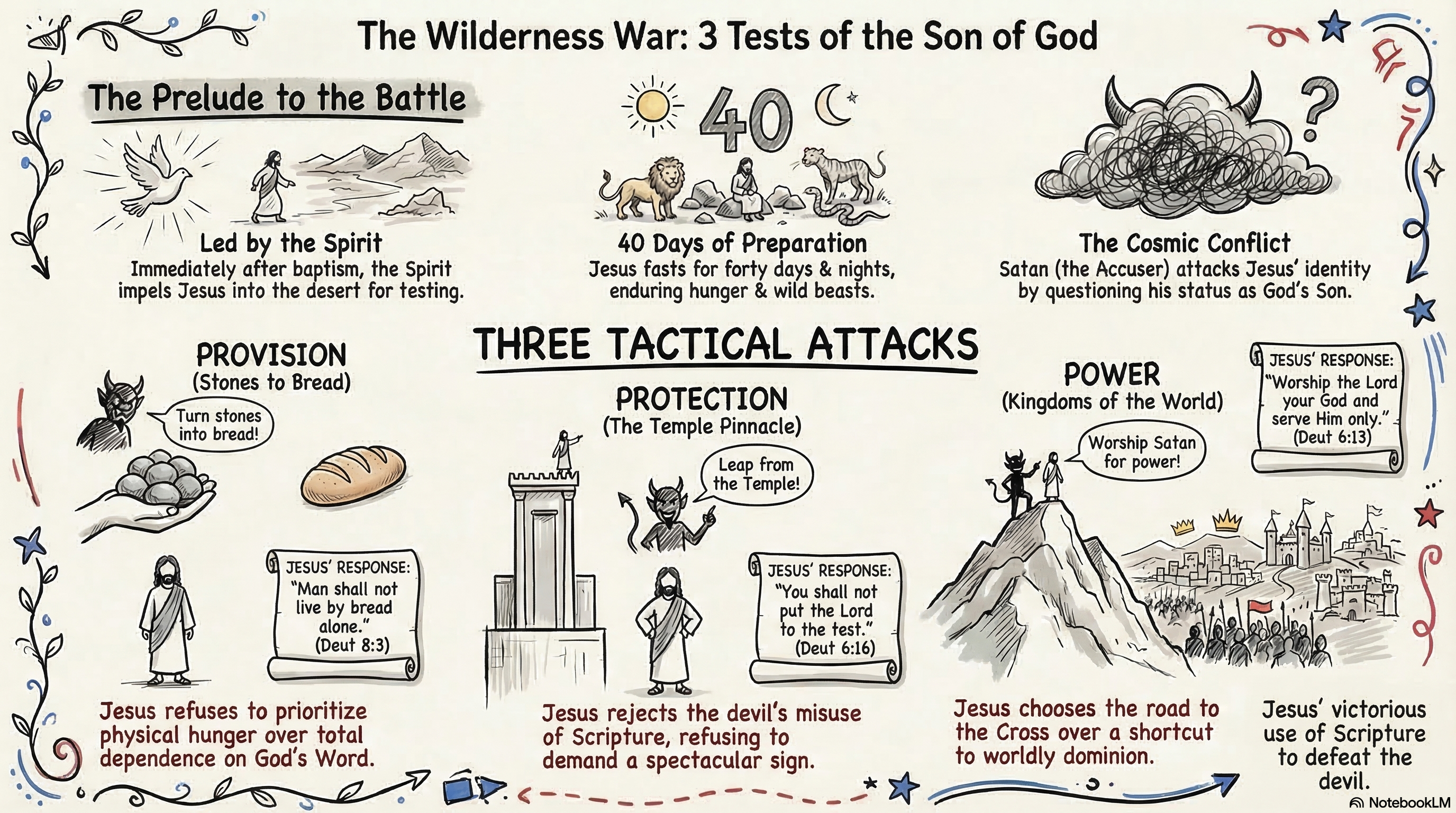
Then comes the first suggestion: if You are the Son of God, command that these stones become bread.
The issue is not whether bread is good. Bread is good. Hunger is not sin. The issue is whether Jesus will use His sonship independently of the Father’s will. Satan presses where need is most acute. Why remain hungry if You have power? Why endure want if You are the Son?
Jesus answers from Deuteronomy 8:3: man shall not live on bread alone, but on every word that proceeds out of the mouth of God.
This response is often quoted, but not always understood. In Deuteronomy, Moses is reflecting on Israel in the wilderness. God let them hunger and then fed them with manna to teach them dependence. Their life did not rest finally on visible provision, but on the word and faithfulness of God.
Jesus takes that truth upon His own lips. He will not seek relief outside the Father’s will. He would rather remain hungry in obedience than be satisfied by disobedience.
That speaks directly to us because many temptations begin with some form of real lack. A real need, a real ache, a real deprivation, a real fear. Then comes the lie: because the need is real, the shortcut must be justified. Because the pain is present, compromise becomes reasonable.
But need does not sanctify disobedience.
A man may feel financial pressure, but deceit is still deceit. A woman may feel lonely, but sin is still sin. A church may feel small and weak, but pragmatism is not made holy by urgency. Jesus teaches us that legitimate desires become dangerous when they are detached from submission to God.
He does not deny that hunger hurts. He denies that hunger has the right to govern Him.
The Second Test: Scripture in the Mouth of the Devil
The next temptation is especially searching because it is clothed in biblical language.
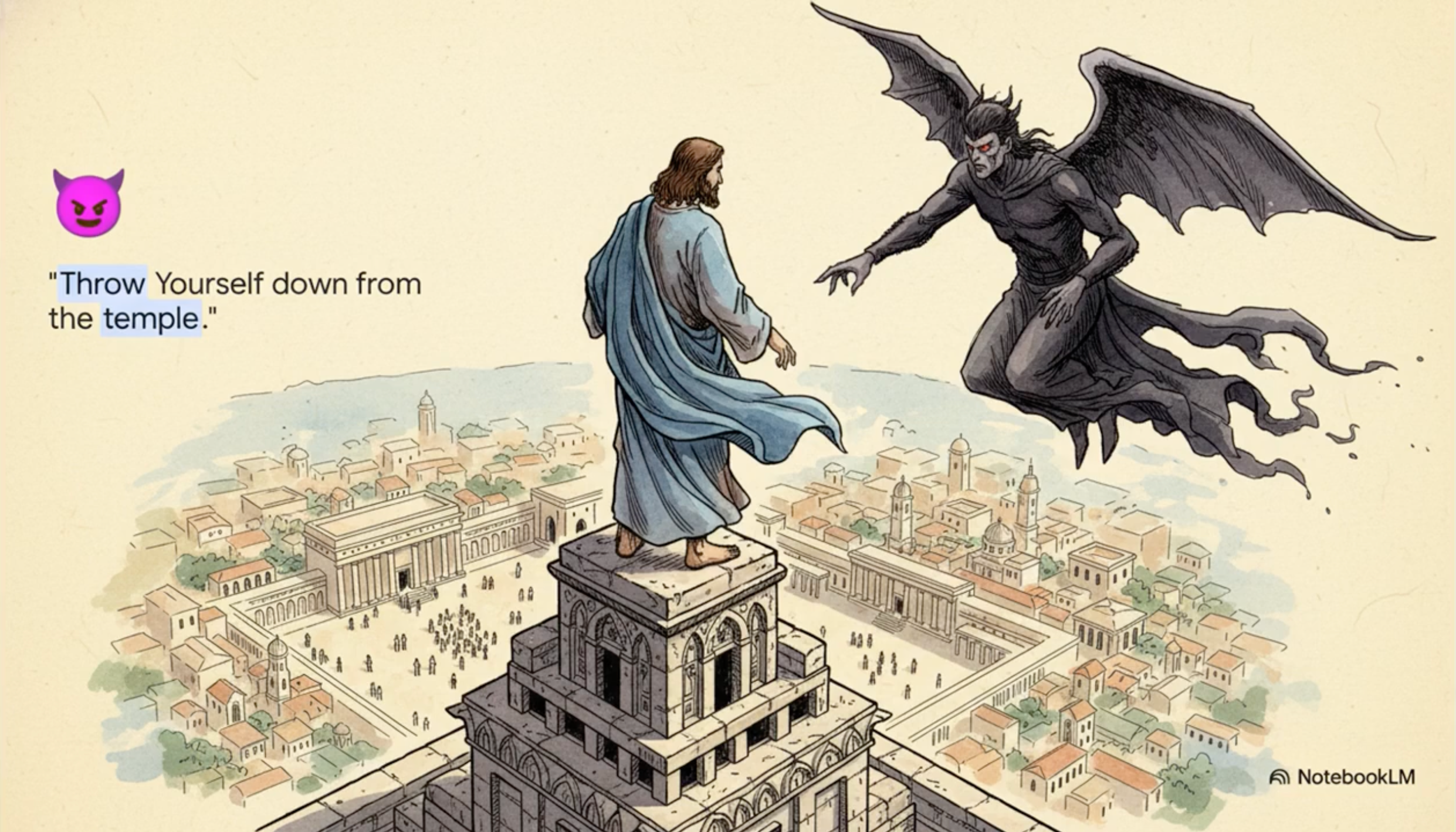
At the temple, Satan quotes Psalm 91. That alone should sober us. The devil is perfectly willing to use Scripture. He is content to sound religious. He can speak the language of trust. He can frame temptation in the vocabulary of faith.
Throw Yourself down, he says in effect, because God has promised to protect You.
This is one of the most necessary lessons in the whole account. Not every use of Scripture is faithful use of Scripture. A verse quoted is not the same thing as a verse understood. Promises may be twisted. Context may be ignored. God’s Word may be dragged into the service of rebellion.
Jesus responds from Deuteronomy 6:16: You shall not put the Lord your God to the test.
That is the heart of the matter. This is not trust. It is testing. It is an attempt to force God’s hand. It is the demand that God prove Himself in a way of our choosing. It is presumption dressed up as faith.
The distinction is crucial. Trust receives God’s promises and walks in obedience. Testing manufactures a crisis and demands divine validation. Trust bows before God’s wisdom. Testing attempts to make God answer on our terms.
Much that passes for faith in religious settings is actually presumption. People make reckless choices, then expect God to protect them from the consequences. They demand signs. They crave public demonstrations. They treat biblical promises as though they were mechanisms for getting dramatic outcomes. They speak of “stepping out in faith” when what they are really doing is stepping outside clear obedience.
Jesus refuses that entirely.
He trusts the Father without forcing the Father. He believes Scripture without abusing Scripture. He will not turn sonship into spectacle.
The church needs that correction. We do not honour God by demanding that He perform for us. We honor Him by walking obediently in the path He has given.
The Third Test: A Crown Without a Cross
Then comes the offer of the kingdoms of the world and their glory. In Matthew, this temptation stands last and ends with Jesus’ firm rebuke: “Go, Satan!” In Luke, the order differs, but the substance is the same. Worship me, and all this will be Yours.
This temptation reaches deep because it offers Jesus something connected to His true mission. He has come to reign. He has come to inherit the nations. He has come to establish the kingdom of God. Satan does not tempt Him with an obviously unrelated prize. He offers Him the end by the wrong means.
That is what makes temptation so dangerous. The worst temptations are often not invitations to pursue openly wicked ends. They are invitations to pursue good ends by sinful methods.
Jesus answers from Deuteronomy 6:13: You shall worship the Lord your God and serve Him only.
Here the deepest issue is uncovered. Temptation is finally about worship. Beneath appetite, beneath fear, beneath ambition, lies the question of allegiance. Who will be obeyed? Who will be trusted? Who will define the path to the promised end?
Satan offers glory without suffering, authority without obedience, kingship without the cross. Jesus refuses. He will receive the kingdom from the Father’s hand, in the Father’s time, by the Father’s way.
This exposes a great many compromises in both personal and church life. A ministry may desire growth, influence, and broad recognition. None of those things is necessarily evil. But if they are gained by muting the truth, entertaining the flesh, flattering the world, or trimming away the offense of Christ, then the price has already been paid in worship. The method reveals the master.
The same is true in ordinary life. A man may want provision, advancement, stability, and honor. Again, none of those aims is automatically sinful. But if he seeks them through lies, impurity, vanity, cowardice, or divided loyalty, then he has accepted the devil’s bargain in principle.
Jesus will not have the crown on Satan’s terms. Neither may we.
Why Jesus Keeps Answering from Deuteronomy
The repeated use of Deuteronomy is not incidental. Jesus is not reaching for random proof texts. He is answering from the very book that reflects on Israel’s wilderness history and calls for covenant loyalty.
That means the wilderness setting is doing theological work. Israel was tested in the wilderness and failed. Israel grumbled over bread. Israel tested God. Israel turned toward false worship. Jesus enters the wilderness and remains faithful exactly where Israel fell.
This is one reason the passage is so rich. It is not merely a portrait of personal resilience. It is the appearance of the faithful Son.
Israel was called God’s son and failed. Adam stood in a place of testing and failed. Jesus stands in hunger, isolation, and pressure, and does not fail. He is the obedient Son, the true Israel, the righteous man who remains steadfast under trial.
That is why believers should read this passage with hope as well as sobriety. Christ does not merely stand before us as an example. He stands for us as the faithful One. He has entered the place of testing and remained obedient. He has not only shown us the path. He has walked it perfectly.
Without that, the passage would crush tender consciences. But with that, it becomes both humbling and strengthening. We see in Christ what we ought to be and what, apart from grace, we are not. Yet we also see the Savior who has obeyed fully and who calls His people to follow Him in the strength that He supplies.
Jesus Did Not Use Scripture Like a Charm
This point needs to be pressed, because it is one of the common failures in Christian application.
The lesson of the temptation narrative is not simply that if we memorize enough verses, temptation will disappear. Memorization matters. Hiding the Word in the heart matters. But Jesus is not using Scripture mechanically. He is not throwing isolated lines into the air as though Bible words were magical formulas.
He knows what the passages mean. He knows their context. He knows their force. He knows how they express the Father’s will. He does not use Scripture as a weapon detached from obedience. He uses it as the truthful expression of a heart submitted to God.
That distinction matters enormously, because people can possess Bible words without having biblical judgment. Some can quote verses and still live by appetite. Some can recite promises and still be ruled by fear. Some can talk about faith and still be testing God. Satan himself quotes Scripture in this passage.
So the call is deeper than “know a few helpful texts.” The call is to know Scripture truly, to receive it humbly, to read it in context, and to bow before what it says. The question is not only whether we can repeat biblical language. It is whether God’s Word has actually formed our instincts, corrected our desires, and governed our choices.
Jesus does not merely quote the Bible. He lives under it.
How Christians Should Apply This Passage
The first application is that temptation often comes through legitimate desires. Hunger, safety, and authority are not evil in themselves. The danger lies in seeking them outside the will of God. Temptation often does not begin with hatred of good things, but with impatience to obtain them.
The second is that temptation usually offers a shortcut. A quicker route. An easier path. A less painful means. The shortcut always promises relief, but it quietly asks for disobedience in return.
The third is that temptation may speak in biblical language. Christians must learn to distinguish between Scripture quoted and Scripture rightly handled. A religious tone is not the same thing as truth. A confident appeal to a verse is not proof of faithfulness.
The fourth is that resisting temptation is usually less dramatic than people want it to be. In this passage, resistance looks like hunger endured, spectacle refused, worship kept pure, and the will of God preferred over immediate advantage. Real spiritual warfare often looks like plain obedience.
The fifth is that the Spirit and the Word must never be set against each other. Jesus is full of the Spirit, and He answers with Scripture. These belong together. The Spirit does not lead us away from the written Word, and biblical fidelity is not lifeless formalism when it is joined to faith. The Christian life is not raw fervor on the one hand or bare correctness on the other. It is Spirit-governed obedience to God’s Word.
And the sixth is that we must never read this text as bare moralism. Before it tells us how to resist temptation, it reveals the One who has resisted perfectly. Before it instructs, it unveils Christ.
The Comfort Hidden in the Severity
This passage is severe, and it should be. It strips away sentimental ideas about temptation. It exposes the seriousness of compromise. It shows us that appetite, religious presumption, and worldly ambition are all capable of becoming roads into disobedience.
But hidden in that severity is deep comfort.
The One who faced the tempter did not fail. The One who stood hungry in the wilderness remained obedient. The One who refused bread apart from the Father now feeds His people as the Bread of Life. The One who refused to test God entrusted Himself to the Father all the way to death. The One who rejected false worship will one day receive the worship of all creation by right, not by theft.
This is not merely the story of how Jesus won a private victory long ago. It is part of the larger revelation of the Son who obeys the Father all the way to the cross. The wilderness points forward. The same Christ who refuses Satan’s shortcuts here will later refuse to come down from the cross at the taunts of men. He will not seize glory by disobedience. He will receive it through obedience.
That is why Christians can read this passage with hope. We are not left merely with commands. We are given Christ. Not only as a pattern, but as a Saviour.
Do Not Read the Wilderness Lightly
Read it with reverence. This is the Son of God meeting the adversary and standing firm.
Read it with honesty. Temptation is real, and the pressure of it is real.
Read it with discernment. Scripture can be misused, even in religious settings.
Read it with self-suspicion. We are often more eager for relief than for holiness, more eager for visible proof than for quiet faithfulness, more eager for influence than for obedience.
And read it with confidence in Christ. The One who stood in the wilderness is not only admirable. He is trustworthy. He is the victorious Son. He has obeyed where others failed, and those who belong to Him are called to follow in His steps.
So do not make peace with temptation. Do not rename shortcuts as wisdom. Do not confuse Bible talk with biblical faith. Do not test God and call it trust. Do not chase the crown by bowing to lesser lords.
Know the Word. Trust the Father. Obey without spectacle. And when obedience feels costly, remember that your Lord has already walked the hard road before you and has not failed.
He did not fail there.
He did not fail at the cross.
And He will not fail His people now.
Thank you for reading, God bless.