The Danger of 'Cultural Christianity' vs. Biblical Faith
- Published on
6 min read
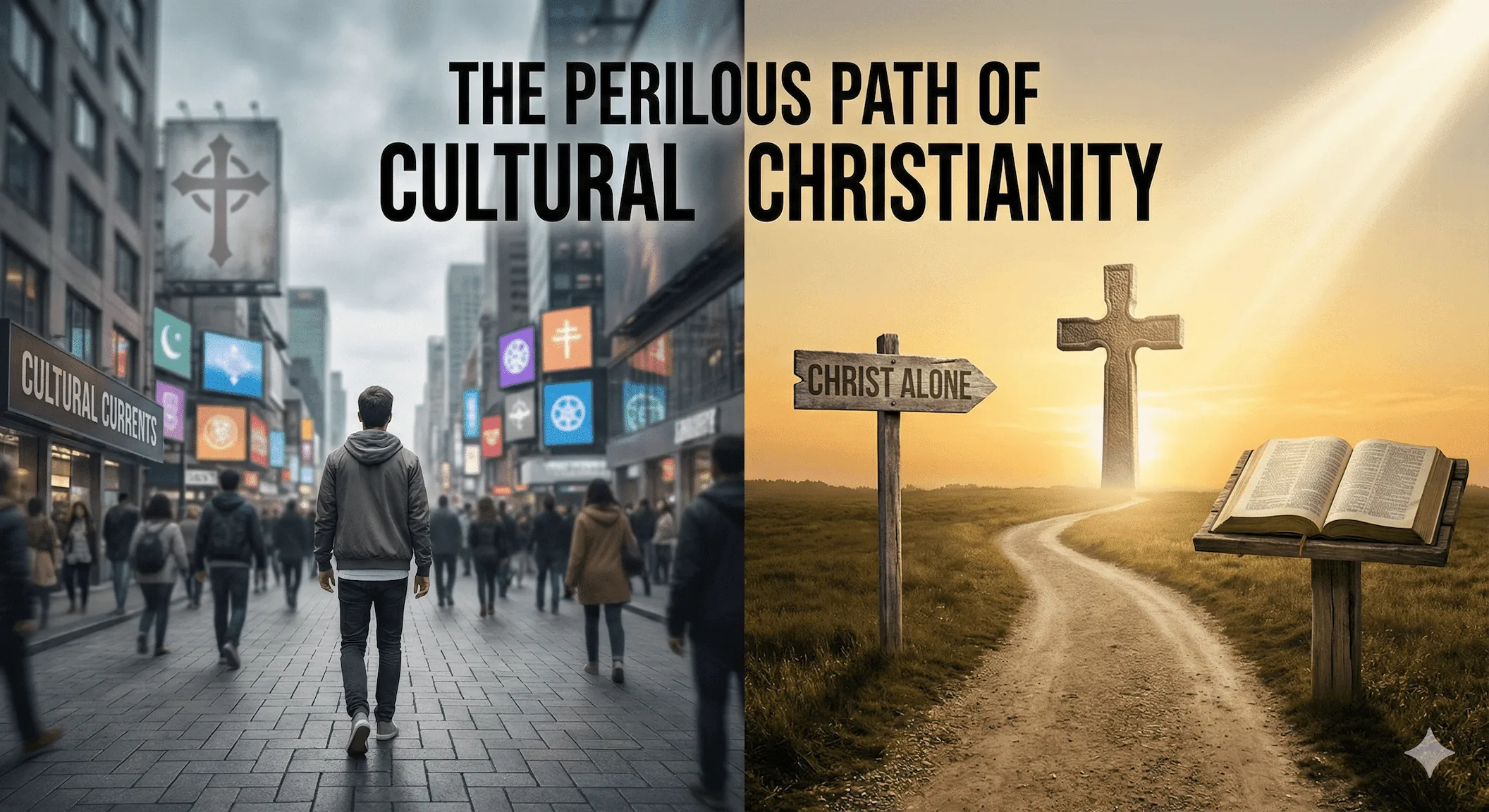
The essence of the Christian life is rooted in faith, but not all expressions labeled “Christian” hold the same saving power. The sources reveal a profound distinction between genuine, biblical faith—a living, transforming trust centered entirely on Christ—and various forms of defective or worldly adherence, which we might collectively term “cultural Christianity.” The latter, often characterized by accommodation to secular thought or moral laxity, poses a severe threat to the integrity of belief and the spiritual life.
The Trap of Cultural Accommodation
“Cultural Christianity” thrives when the church allows its principles to be shaped by the surrounding world rather than the Word of God. This results in a widespread dilution of doctrine and morality:
- Idolatry of the Age: The church faces the danger of being built according to man’s wisdom, relying on cultural preferences, philosophical systems, or pragmatic techniques for growth. The real spiritual conflict is seen as a battle between “Christianity and Paganism, the idols and the living God”. In some professing churches today, intellectualism, “culture,” and modern thought are treated as “the idol of the hour”.
- Substitution of Human Wisdom: There is a persistent danger of substituting human philosophies or cultural opinions for biblical teaching. Modern thought often rejects biblical teachings as mere notions of ancient cultures, leading to skepticism, absurdity, and infidelity. When the historical foundations of the Bible are undermined, Christianity risks collapsing into subjective opinions and feelings, which are insufficient for salvation.
- Worldliness and Moral Decay: The current age displays rampant worldliness, with holiness being ridiculed. The tyranny of the world demands obedience to its fashions and rules. Christians are warned against allowing their thinking to be approximated and assimilated to the world around them. This mixing with the customs of the world leads to unhappiness and prevents true spiritual progress. Moral standards decline when the underlying faith is compromised. Furthermore, replacing the moral law of God with emotional subjectivism constitutes a “wholesale rejection of the moral law of God”.
- Prioritizing Personal Satisfaction: Culture often defines man by emotional health, believing that the central goal of life is to be happy and feel good about oneself. This contrasts sharply with the Christian worldview, which subordinates immediate personal satisfaction to repentance from sin, self-denial, and sacrificial service for the sake of loving God and others.
The Insufficiency of Defective Faith
A major pitfall of “cultural Christianity” is mistaking various forms of inadequate belief for saving faith, demonstrating a lack of commitment to the Christ revealed in Holy Scripture.
- Bare Assent vs. Trust: Saving faith is fundamentally different from the mere mental belief (historical faith) or bare credence found even in devils (Matthew 8:29). Faith is not simply intellectual agreement with truth.
- Experience Over Scripture: When faith is reduced to a vague feeling, an unbiblical subjective encounter, or an existential leap into the unknown, it becomes unstable and insufficient. Resting faith on personal experience without standing on the clear teachings of the written Word is disastrous, leading followers to pursue an inner light as if it were the Spirit, resulting ultimately in the worship of self.
- The Problem of Doctrinal Reductionism: It is exceedingly dangerous to hold the position that doctrinal definitions do not matter, so long as people speak of the cross. Heresies, which are often perpetrated by seemingly sincere and devout people, lead to grievous evils. Without specific truths to cling to, this mindless Christianity becomes spineless, eventually leading to a Christless Christianity.
The Hallmarks of Biblical Faith
In sharp contrast to cultural accommodation, true biblical faith is a profound commitment to the person and work of Jesus Christ, grounded solely in the Word of God.
Biblical faith is Christ-Centered and God-Grounded: The object of saving faith is not faith itself, but Christ alone. True faith looks to God as the only One who is all-sufficient to save and satisfy.
- Knowledge and Assent: Faith begins with certain knowledge of God’s revelation in the Holy Scriptures. It is a firm conviction and unhesitating assurance of the truth of God’s testimony and the fulfillment of His promises. This belief must be in the Christ revealed to us by God in Holy Scripture, not an abstract idea or a Christ of our imagination.
- Confident Trust (The Embrace): Saving faith is defined as confident trust in Christ. It is described as rolling and staying upon God, cleaving and adhering to Him, and receiving and resting upon Christ alone for salvation. This is not a distant view, but a “warm embrace of Christ” by which the soul is united to Him. This faith relies on Christ’s finished work, appropriating His perfect righteousness.
- A Transforming Relationship: Faith is an inward experiential look that reorients the entire being Christward, changing the person and creating a new nature. It causes a soft, bleeding heart when looking at a bleeding Christ, sanctity when looking at a holy Christ, and humility when looking at a humble Christ. This faith involves action.
The Indispensability of Obedience: True faith is evidenced by obedience. It is not merely a ticket to heaven, but a principle of life. The path to God by Jesus Christ is called “the way of holiness”. Faith produces a life of good works. The requirement for Christian life is keeping “oneself from being polluted by the world”. We must read the Bible covenantally, responding with faith and obedience toward Christ.
Conclusion: Staying True to the Biblical Foundation
The danger of “cultural Christianity” lies in its willingness to trade the absolute, unchanging truths of God’s Word for the shifting sands of human opinion and cultural accommodation.
If we desire genuine spiritual life, we must reject the idols of the hour and return to the foundation of Scripture alone (Sola Scriptura). The Bible is our supreme and only rule of faith and life. It is the foundation that speaks of the uniqueness of Christianity.
We must recognize that Christ is all, and our knowledge of Him rests confidently on what God declares in His Word. We are saved by grace through faith, and that faith is a living, energetic motion of the heart that clings to God and produces obedience.
To navigate the perilous waters of cultural conformity, the believer must constantly consult the Word of God. Cultural Christianity functions like a GPS based on current human trends, constantly redefining truth to be palatable; conversely, biblical faith operates like a compass fixed on true North (Christ), relying on the unbreakable and infallible Word of God to guide us on the way of holiness.
References and Further Reading
- Beeke, Joel R. 2013. *A Puritan Theology: Doctrine for Life*. Grand Rapids: Reformation Heritage Books.
- Beeke, Joel R., and Paul M. Smalley. 2019. *Reformed Systematic Theology: Man and Christ*. Wheaton, IL: Crossway.
- ———. 2020. *Reformed Systematic Theology: Revelation and God*. Wheaton, IL: Crossway.
- ———. 2021. *Reformed Systematic Theology: Spirit and Salvation*. Wheaton, IL: Crossway.
- Berkhof, Louis. 1941. *Systematic Theology*. Grand Rapids: Eerdmans.
- Cole, R. Alan. 1989. *TNTC Galatians*. Downers Grove, IL: InterVarsity Press.
- France, R. T. 2007. *TNTC Matthew*. Downers Grove, IL: InterVarsity Press.
- Gulley, Norman R. 2005. *Systematic Theology*. Vol. 1, *Revelation and God*. Berrien Springs, MI: Andrews University Press.
- ———. 2007. *Systematic Theology*. Vol. 3, *Creation, Christ, and the Holy Spirit*. Berrien Springs, MI: Andrews University Press.
- ———. 2010. *Systematic Theology*. Vol. 4, *The Church and the Last Things*. Berrien Springs, MI: Andrews University Press.
- Guthrie, Donald. 1994. *TNTC Hebrews*. Downers Grove, IL: InterVarsity Press.
- ———. 2009. *TNTC Pastoral Epistles*. Downers Grove, IL: InterVarsity Press.
- Hodge, Charles. 1871–1873. *Systematic Theology*. Vol. 1. New York: Scribner, Armstrong, and Company.
- ———. 1871–1873. *Systematic Theology*. Vol. 3. New York: Scribner, Armstrong, and Company.
- Kruse, Colin G. 2003. *TNTC 2 Corinthians*. Downers Grove, IL: InterVarsity Press.
- Lockyer, Herbert. 2016. *All the Promises of the Bible*. Glasgow: Christian Focus Publications.
- Lloyd-Jones, D. Martyn. 2017. *The Baptism and Gifts of the Spirit*. Bellingham, WA: Lexham Press.
- Moo, Douglas J. 2015. *TNTC James*. Downers Grove, IL: InterVarsity Press.
- Morris, Leon. 1978. *TNTC 1&2 Thessalonians*. Downers Grove, IL: InterVarsity Press.
- Spurgeon, Charles Haddon. 1856. *Spurgeon – Metropolitan Tabernacle Pulpit Vol. 02*. London: Passmore & Alabaster.
- ———. 1857. *Spurgeon – Metropolitan Tabernacle Pulpit Vol. 03*. London: Passmore & Alabaster.
- ———. 1864. *Spurgeon – Metropolitan Tabernacle Pulpit Vol. 10*. London: Passmore & Alabaster.
- ———. 1868. *Spurgeon – Metropolitan Tabernacle Pulpit Vol. 14*. London: Passmore & Alabaster.
- ———. 1871. *Spurgeon – Metropolitan Tabernacle Pulpit Vol. 17*. London: Passmore & Alabaster.
- ———. 1872. *Spurgeon – Metropolitan Tabernacle Pulpit Vol. 18*. London: Passmore & Alabaster.
- ———. 1877. *Spurgeon – Metropolitan Tabernacle Pulpit Vol. 23*. London: Passmore & Alabaster.
- ———. 1878. *Spurgeon – Metropolitan Tabernacle Pulpit Vol. 24*. London: Passmore & Alabaster.
- ———. 1886. *Spurgeon – Metropolitan Tabernacle Pulpit Vol. 32*. London: Passmore & Alabaster.
- ———. 1887. *Spurgeon – Metropolitan Tabernacle Pulpit Vol. 33*. London: Passmore & Alabaster.
- ———. 1893. *Spurgeon – Metropolitan Tabernacle Pulpit Vol. 39*. London: Passmore & Alabaster.
- ———. 1902. *Spurgeon – Metropolitan Tabernacle Pulpit Vol. 48*. London: Passmore & Alabaster.
- ———. 1904. *Spurgeon – Metropolitan Tabernacle Pulpit Vol. 50*. London: Passmore & Alabaster.
- ———. 1907. *Spurgeon – Metropolitan Tabernacle Pulpit Vol. 53*. London: Passmore & Alabaster.
- ———. 1909. *Spurgeon – Metropolitan Tabernacle Pulpit Vol. 55*. London: Passmore & Alabaster.
- ———. 2014. *Spurgeons Commentary On The Whole Bible: Spurgeons Bible Commentaries*. Edited by Edward T. Hiscox. Bellingham, WA: Logos Bible Software.
- Tom, Blackaby, and Richard Blackaby. 2021. *The Commands of Christ: What It Really Means to Follow Jesus*. Nashville, TN: B&H Publishing Group.
- Wright, N. T. 1986. *TNTC Colossians & Philemon*. Downers Grove, IL: InterVarsity Press.
Thank you for reading, God bless.